
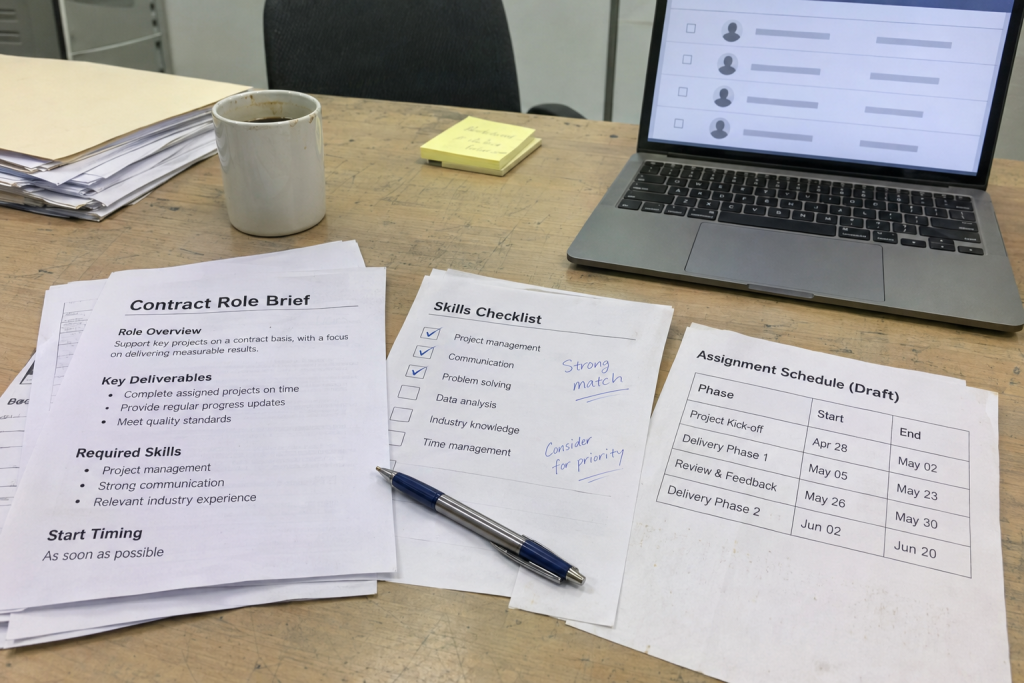
When an urgent assignment opens, the “employee or contractor Canada” decision affects how you define the work, assess candidates and prepare the agreement. The faster you settle the assignment’s scope and work model, the sooner you can publish a credible opportunity and make a confident decision.
Why contract talent is part of workforce planning
Contract talent can help employers respond to a defined workload, a temporary skills need or a project with a clear end point. HR Reporter’s report on a survey of hiring managers says more than seven in 10 are likely to hire contract talent. For employers, the practical question is how to make these roles ready to fill without creating avoidable delays or unclear expectations.
Start by identifying the work that is urgent and can be described as a distinct assignment. A contract label alone will not make a role easier to staff. Candidates need to understand what they will deliver, what skills they need, when the work begins and how the assignment fits with the rest of the team.
Use demand signals to decide when to prepare a role brief in advance. Consider recurring workload peaks, project milestones, backlogs and skills that are difficult to source at short notice. For broader planning around changing labour conditions, see these ways to plan for policy uncertainty.
Employee or contractor Canada: settle the work model first
“Contract worker” can describe different relationships. A person may be an employee hired for a limited term, or a self-employed contractor engaged to provide services. Those arrangements are not interchangeable, and the label in an agreement or an invoice does not decide a worker’s status.
The Canada Revenue Agency considers factors such as control, tools, the chance to subcontract, financial risk, investment and the chance of profit when assessing whether someone is an employee or self-employed. The test differs if the contract is formed in Quebec. A provincial employment-standards body may also classify the same worker differently from the CRA.
Resolve the question before advertising if the working relationship is not clear. Either party can ask the CRA for a CPP/EI ruling. If the role is employment, prepare for the applicable payroll and employment-standards requirements; do not assume that calling it a contract removes those responsibilities.
Write a brief that lets the right people self-select
A focused role brief saves time by helping candidates assess fit before they apply. Describe the deliverable or service, the essential skills, the work location or arrangement, the expected start timing and the anticipated assignment duration if it is known. State any required availability or schedule clearly, rather than leaving candidates to infer it.
Separate must-have qualifications from preferences. If a credential, tool or particular experience is necessary from the first day, say so and explain what the person will use it to do. Avoid long lists of desirable attributes that do not affect the work; they can deter qualified candidates and make screening less consistent.
Set out the engagement terms you can confirm, including the pay structure or rate, how the work will be assessed and who will answer assignment questions. Check the rules that apply where the work will be performed before publishing the ad. Requirements can differ by jurisdiction, and there is no single set of employment standards for every Canadian employer.
Prepare the decision before applications arrive
Contract hiring can still stall when no one knows who can approve a shortlist, confirm the scope or make the offer. Before posting, name the decision-maker and a backup, agree on the skills that will determine fit, and reserve time for interviews or assessments. Ask the team lead to be available for role-specific questions while the posting is active.
Keep the assessment proportionate to the assignment. Use a short, structured conversation focused on relevant skills, availability and the proposed work. If you request a work sample, make sure it tests a real requirement of the assignment and give candidates clear instructions about what you expect.
Agree in advance on how quickly interview feedback will be collected and who can make the final decision. A simple scorecard tied to the essential criteria can help decision-makers compare candidates on the same basis. It also reduces the risk of adding new requirements late in the process.
Build a shortlist around availability and evidence
For a time-sensitive assignment, relevant capability is only part of the match. Confirm when candidates can start, whether they can meet the stated schedule and whether the assignment’s expected duration works for them. Ask about experience that demonstrates the required skill, rather than relying only on job titles or broad claims in a résumé.
Use a consistent screening sequence so each application receives a timely, comparable review. First check the stated essentials; then clarify availability and any material gaps; finally, move the strongest matches to a decision-maker. Keep notes focused on job-related criteria and handle applicant information in line with your privacy obligations.
References or other checks should be connected to the role and completed with appropriate consent. A criminal record check is not a general requirement for every Canadian hire, and the rules can vary by province and job. Decide whether a check is relevant before you advertise, rather than making it an unexpected condition after selecting someone.
Make the offer and handoff ready
Once you select a candidate, delays can continue if the terms are still being assembled. Prepare the appropriate written agreement and confirm the assignment scope, start date, reporting contact, payment arrangements and any conditions that apply. Have the relevant internal reviewer check the terms before the final candidate is waiting for an answer.
If the person is an employee, account for payroll setup and the employment standards that apply where the employee works. If the relationship is self-employment, make sure the actual working arrangement reflects that status; the contract wording cannot settle classification by itself. Where facts remain uncertain, get advice before the engagement starts.
Plan how the person will receive access, tools, safety information and the context needed to begin. Identify a contact for questions and schedule a check-in around the work, not just the paperwork. For longer-term workforce continuity, employers may also find this guidance on retention planning when permits are longer useful.
Post with the essentials in place
Before publishing, review the ad as a candidate would. Can someone quickly understand the work, the required skills, the location, the expected timing and how to apply? Remove vague requirements, confirm the details with the hiring lead and ensure the posting describes a real opportunity with terms your organization can support.
National Jobs is a Canadian job board that connects employers with job seekers across Canada. Employers can create a National Jobs account and check current job posting prices before publishing. A posting on National Jobs is separate from a posting on Job Bank, so choose the channels that fit your recruitment plan.
Contract talent is most useful when the assignment is clear and the organization can act promptly. Define the work model, prepare the brief, align decision-makers and have the agreement and onboarding steps ready. When you are ready to reach candidates, post a job on National Jobs.