
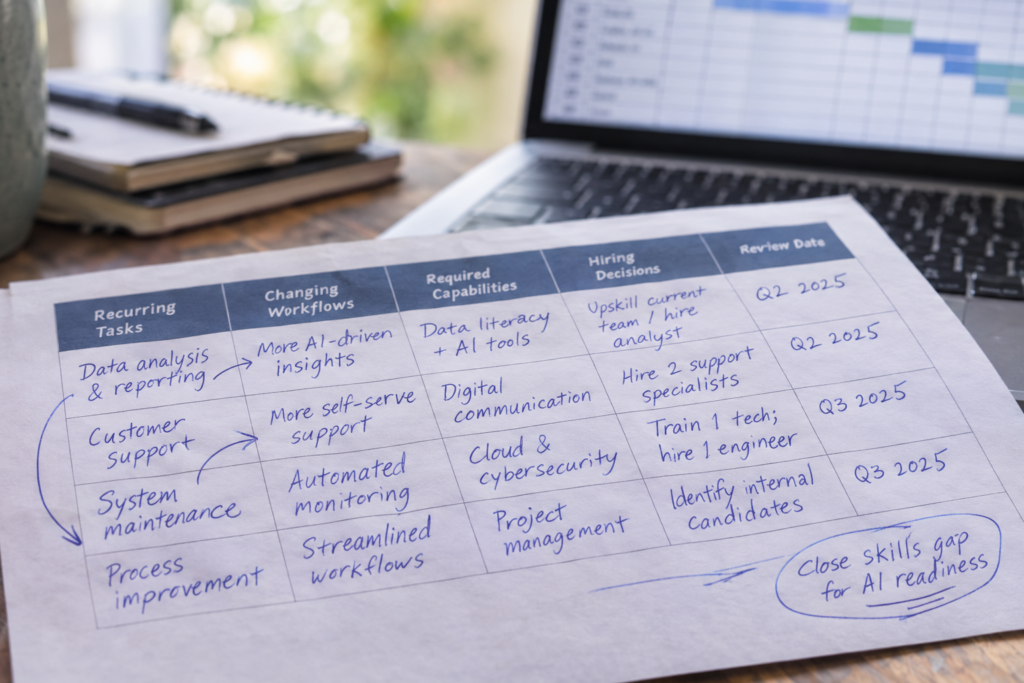
A skills gap Canada plan matters to employers because AI can alter the tasks a team needs to complete before a job title or vacancy changes. If you hire against last year’s role design, you may recruit for work that is shrinking while overlooking the capabilities your team will need next.
What the skills gap Canada signal means for this quarter
HR Reporter’s coverage of a workforce-planning report says only one in ten employers factor AI’s impact into workforce plans. For your hiring plan, the practical issue is not predicting exactly what a technology will do. It is deciding which work is changing, what skills that work now requires and whether hiring is the right response.
Use the finding as a reason to review assumptions, not as a target to copy. Your organization may be testing tools, using them in limited workflows or not yet relying on them. The hiring decision should reflect your own approved use, operational needs and evidence about the work—not a general forecast about what AI might eventually automate.
This quarter, connect workforce planning to specific vacancies and workload decisions. A role should have a clear business need, defined outputs and a realistic account of which tasks remain human-led, are supported by tools or could change. That gives hiring managers a firmer basis for deciding whether to recruit, redesign the work or build capability in the existing team.
Map tasks before you change headcount
Start with the work, not the job title. For each team with a planned vacancy or a material workload change, list recurring tasks, the output each task produces, who relies on it and the capabilities needed to complete it. Ask managers to distinguish between tasks that are already changing and tasks that are only expected to change.
Then record the evidence behind each expected change. It could include a tested workflow, a documented process change, a recurring bottleneck or a requirement from an internal user. Mark assumptions separately from observed results, and give each assumption an owner and a review date. This prevents an untested expectation about automation from becoming an unexplained reduction in staffing or a vague new job requirement.
Keep the inventory at a useful level of detail. You do not need an exhaustive catalogue of every action an employee takes. Capture enough to see where work is repetitive, where judgement or accountability matters, where errors have consequences and where a person must interpret or communicate the result. Those distinctions can reveal whether the gap is in capacity, technical knowledge, review skills or another capability.
Decide whether to hire, redesign or develop skills
For each gap, compare the required capability with the capacity already available. Consider current skills, expected workload, the time needed to develop the capability and whether the work must be done by a new employee. Avoid treating “AI skills” as a complete requirement: specify the actual tasks, tools or decisions the role will involve, and what competent work looks like.
Use consistent decision criteria across teams. For example, ask whether the capability is needed immediately, whether the work is expected to continue, whether it can be learned within a reasonable period for your operation and whether another team can provide the support. These are questions for your own managers to assess; they are not reasons to assume that every capability gap calls for a new permanent position.
When deciding among options, document the chosen response and what would cause you to reconsider it. A gap may call for recruiting, adjusting responsibilities, training current staff or waiting for a planned workflow to be tested. If the evidence is not strong enough to justify a permanent role, define a checkpoint rather than allowing an open-ended vacancy or an informal change in workload.
Turn the decision into a specific job requirement
When recruitment is the right response, write the role around outcomes and essential capabilities. Separate skills needed on the first day from those that can be developed, and distinguish mandatory qualifications from preferences. Be precise about the work the new employee will own, the decisions they will make and any review or quality-control responsibility connected to AI-supported tasks.
A well-defined role also helps managers avoid hiring for familiarity with a particular tool when the actual need is broader judgement, analysis or communication. Identify how candidates can demonstrate the capabilities you need, and ensure the stated requirements are genuinely connected to the work. For support on structuring duties and requirements, see this guide to preparing a Canadian job description.
Before posting, have the hiring manager and the person responsible for the workflow agree on the role’s scope. Confirm that the workload supports the position, that responsibilities do not conflict with existing roles and that the proposed tools are available and approved for the work. If the role is still changing, state what is known and avoid promises about duties or technology that have not been settled.
Assess capability with evidence, not buzzwords
Build your assessment around the work candidates would actually perform. Use structured questions, job-related tasks or a review of relevant work where appropriate, and set consistent criteria before interviews begin. Assess how candidates check information, explain a decision, recognize uncertainty and take responsibility for an output when those abilities matter to the role.
Do not assume that someone who has used an AI tool can apply it appropriately in your workflow. Equally, avoid ruling out a candidate merely because they have not used a particular product if the essential capability is transferable. Decide what evidence is relevant to the role, give candidates clear instructions and apply the same assessment standards to applicants for the same position.
If a hiring process uses AI to screen, assess or select applicants, check the rules that apply where the job is located. In Ontario, the public job-posting requirements apply to employers with 25 or more employees in Ontario on the day the posting goes up, and a publicly advertised posting must say if AI is used to screen, assess or select applicants. Do not assume this specific requirement applies across Canada; verify the current requirements for each work location.
Check the employment arrangement and location
A change in the work can lead managers to propose a different arrangement, such as engaging someone for a defined service rather than hiring an employee. Do not use a contract label as a shortcut. Whether a person is an employee or self-employed depends on the working relationship, and the relevant assessment can vary. Review the factors and considerations in this guide to employee or contractor classification in Canada before settling the arrangement.
Also check the jurisdiction where the employee will work before finalizing terms or a posting. Most Canadian employers are covered by provincial or territorial employment standards, while some industries and businesses are federally regulated. Do not apply one jurisdiction’s employment rules to every role simply because the hiring plan spans several provinces or territories.
For a role that may be affected by a reorganization, make the decision process especially clear. Record who approved the change, what work remains, what the new role is expected to do and when the need will be reviewed. If responsibilities or reporting lines change, ensure the written job information and the actual work stay aligned.
Use a short quarterly review to keep the plan current
Put a recurring review on the calendar for the roles most affected by changing workflows. The purpose is not to reopen every hiring decision each week. It is to compare the assumptions behind the decision with what has happened and act if the workload, quality requirements or capability needs have materially changed.
Use a short record for each role or team. Include the task or capability gap, the evidence supporting the need, the selected response, the accountable manager and the next review point. Track whether the vacancy is approved, whether the job requirements have been validated and what would trigger a change in the plan. This creates an auditable management rationale without pretending that forecasts are certain.
Concrete steps for this quarter:
- List planned vacancies and identify the tasks most likely to change in each role.
- Ask managers to label each forecast as observed, tested or still an assumption.
- Compare required capabilities with current team capacity before opening a requisition.
- For approved hiring, define essential outcomes, assessable skills and the evidence candidates should provide.
- Check the work location and applicable hiring requirements before publishing the posting.
- Set an owner and review point for every material assumption behind the workforce plan.
Make the next hiring decision more deliberate
A useful workforce plan does not need perfect predictions. It needs a clear link between the work changing, the capability required and the decision to hire or use another response. If managers cannot explain that link, pause to clarify the role before spending time recruiting against an uncertain brief.
When the role and requirements are ready, publish an accurate job ad that reflects the real vacancy and the work candidates will perform. National Jobs connects employers with job seekers across Canada. Create an employer account and post a job on National Jobs when you are ready to recruit.