
Rural vacancies can stay open when employers take too long to identify qualified applicants or make screening requirements hard to understand. Screening candidates Canada-wide calls for a clear, consistent process that helps your team assess job fit promptly without confusing skills evaluation with immigration decisions.
Use the rural immigration news as a prompt, not a screening shortcut
Immigration, Refugees and Citizenship Canada launched the Rural Community Immigration Pilot in January 2025, as reported in the Government of Canada’s overview of the Rural Community Immigration Program. For employers, the practical takeaway is to prepare for recruitment in communities facing labour-market and demographic challenges, while checking current official information before relying on any program details.
Do not treat a candidate’s possible connection to an immigration pathway as proof of job suitability, work authorization or program eligibility. Assess the person against the role’s requirements, and handle immigration and work-authorization questions as a separate compliance matter. For foreign-worker processes, consult the current information from Employment and Social Development Canada and Immigration, Refugees and Citizenship Canada rather than assuming a particular pathway applies.
That separation keeps the hiring decision focused. It also reduces the risk of turning an unverified assumption into a screening rule that delays or unfairly excludes qualified applicants.
Screening candidates Canada: define the decision before applications arrive
Before publishing a vacancy, decide what the hiring team must learn at each screening stage. Identify the essential tasks, the skills needed on entry, any credentials or licences required for the work, and the conditions the successful candidate must be able to meet. Keep preferred qualifications separate from genuine requirements.
Make each criterion observable. “Strong communicator” is difficult to assess consistently; explaining information to customers, recording work accurately or coordinating with a team are clearer behaviours to evaluate when they are relevant to the role. This also helps reviewers distinguish a missing qualification from a different way of describing relevant experience.
Use the same core criteria for every applicant being considered for the same vacancy. Assign a reviewer to each criterion and agree on what evidence would meet it before reviewing applications. A structured role description can help clarify duties and requirements; see this guide to structuring a Canadian job description for related considerations.
Make the first review brief, relevant and consistent
Set an initial screen that checks only the information needed to decide whether a candidate should move forward. For example, review evidence of required skills, relevant credentials and stated availability where those matters are genuinely necessary for the job. Avoid making a long application form the first hurdle if the information does not affect the next decision.
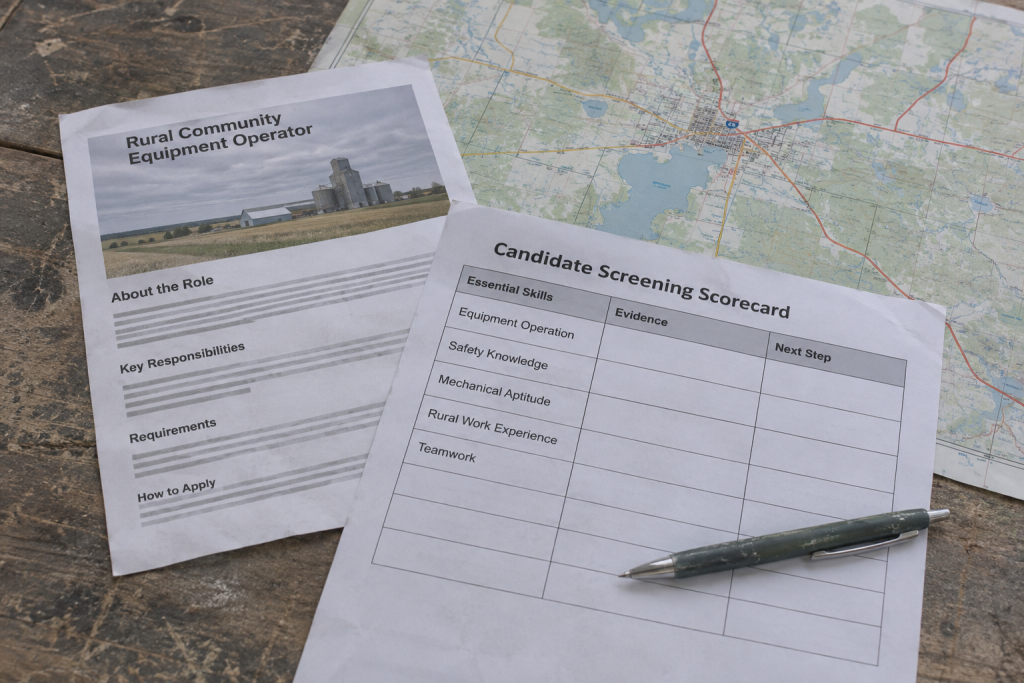
Use a simple scorecard with the criteria listed in advance, a space to record evidence and a clear outcome such as advance, clarify or do not advance. A short evidence note is more useful than a vague rating: it lets the next reviewer understand why a decision was made without repeating the entire review.
- Separate mandatory requirements from preferences before applications arrive.
- Review each application against the same criteria and record job-related evidence.
- Mark missing information for clarification rather than guessing what it means.
- Set a review deadline and identify a backup reviewer for periods of absence.
Do not let a screening score replace judgment. If an application uses unfamiliar wording or presents experience in a different format, consider whether it demonstrates the required capability before rejecting it. Apply the human-rights requirements that cover the workplace and the job location; legal rules can differ across jurisdictions.
Use focused questions to resolve gaps early
When an application leaves a material point unclear, ask a concise, job-related question instead of putting the candidate through a full interview. Use the same question for applicants with the same information gap, and explain what information you need and when you need it. This can prevent avoidable interview rounds while preserving a fair comparison.
Prepare a short set of structured questions for the first conversation. Ask each candidate the same core questions about the work’s essential tasks, and use follow-ups only to clarify their answers. Questions should test relevant knowledge or behaviour, not personal circumstances unrelated to the job.
For practical assessments, define the task, evaluation criteria and time expectations in advance. Keep the exercise tied to actual job duties and use the same approach for candidates being compared. If the work requires a credential or other qualification, verify what is required for the role and where it must be recognized rather than relying on assumptions about a candidate’s background.
Remove delays between assessment stages
Fast screening depends on decisions and communication as much as on interview length. Decide who has authority to advance a candidate, who can approve an offer and what information each person needs. If reviewers have to restart discussions at every stage, even a strong applicant may wait while the team catches up.
Set a realistic response standard for your hiring team and tell candidates what the next step will be. When an interview or reference step is necessary, schedule it promptly and avoid adding rounds that do not answer a distinct job-related question. If a decision is delayed, give the candidate a brief update rather than leaving them without information.
- Review applications on a regular schedule instead of waiting for the posting to close.
- Book first conversations as soon as a candidate meets the agreed screen.
- Collect feedback in one shared place and set a deadline for reviewers.
- Keep a decision-maker available to resolve disagreements or approve the next step.
- Tell candidates when they can expect an update, and contact them if that timing changes.
Keep only the candidate information your hiring process needs, limit access to people involved in the decision and follow applicable privacy requirements. A faster process should remove unnecessary waiting, not dispense with careful handling of personal information.
Check whether the work terms are clear and credible
Candidates may be unable to judge an opportunity if the posting leaves important conditions vague. State the work location, duties, schedule expectations, required qualifications and the process for applying as accurately as possible. Where the work involves travel, unusual shifts or a specific worksite, make those conditions clear early so candidates can assess fit before an interview.
Review compensation before launch and make sure the proposed terms are defensible for the role and location. Minimum wage rules differ by jurisdiction, so do not rely on one national figure. This guide to setting a pay floor by province can help employers identify what to check; confirm the current requirements for the location where the employee will work.
Be precise about what is required at application and what can be confirmed later. Asking for documents or details before they are needed can create extra work for both the applicant and the hiring team. If you need to verify a qualification or reference, tell the candidate what you need and when it will be requested.
Keep a record and improve the screen after each vacancy
Retain a concise record of the criteria, assessment steps and reasons for key decisions in line with your organization’s retention practices and applicable law. A consistent record helps the employer explain how candidates were assessed and identify whether the process is working as intended. Avoid recording irrelevant personal impressions.
After the vacancy is filled—or if it remains open—review where candidates paused or withdrew. Look for process issues you can act on, such as unclear requirements, slow review, repeated scheduling difficulties or an assessment that did not help distinguish job-related skills. Use that evidence to adjust the next screen rather than adding more steps automatically.
Also check the handoff from recruitment to the person responsible for employment documentation and onboarding. Confirm that the job terms, start arrangements and required checks are clear before making commitments. Retaining a candidate through a decision is useful only if the employer can move from selection to a well-prepared start.
Turn a better screen into a timely vacancy
A rural hiring process cannot control every factor affecting the labour supply, and no screening method guarantees a hire. Employers can control whether requirements are clear, assessments are relevant, decisions have owners and candidates receive timely updates. Those basics make it easier to recognize suitable applicants without lowering the standard for the work.
National Jobs connects employers with job seekers across Canada. Create an employer account to post a vacancy, and check current job posting prices before you publish.